A/B Testing Your Email Campaigns for Maximum ROI

You're sending thousands of emails, but are you really optimizing for results? Most marketers send the same email to their entire list and hope for the best. The smart ones test, learn, and iterate.
A/B testing (also called split testing) is the difference between guessing what works and knowing what works. In this guide, you'll learn how to run effective email A/B tests that actually improve your ROI—not just generate vanity metrics.
Why A/B Testing Matters (More Than You Think)
Let's say you're sending 50,000 emails per month with a 20% open rate and 2% click rate. That's 10,000 opens and 1,000 clicks.
Now imagine you improve your open rate to 25% through subject line testing. That's 12,500 opens—2,500 more people seeing your message. If you maintain the same 2% click rate, you just gained 500 additional clicks without sending a single extra email.
The math:
- 5% improvement in open rate = 25% more clicks
- 0.5% improvement in click rate = 25% more conversions
- Combined = 56% more conversions from the same list
That's the power of A/B testing.
What You Can (and Should) Test
High-Impact Tests (Start Here)
1. Subject Lines
- Impact: High (directly affects open rates)
- Difficulty: Easy
- Test frequency: Every campaign
2. Send Time
- Impact: High (can double open rates)
- Difficulty: Easy
- Test frequency: Quarterly
3. From Name
- Impact: Medium-High
- Difficulty: Easy
- Test frequency: Quarterly
4. Call-to-Action (CTA)
- Impact: High (directly affects conversions)
- Difficulty: Medium
- Test frequency: Every major campaign
Medium-Impact Tests
5. Email Copy Length
- Short vs. long-form content
- Impact: Medium
- Test frequency: Monthly
6. Personalization
- First name, company, behavior-based
- Impact: Medium
- Test frequency: Monthly
The A/B Testing Framework That Actually Works
Step 1: Form a Hypothesis
Don't just test randomly. Start with a hypothesis based on data or best practices.
Bad hypothesis: "Let's test two different subject lines"
Good hypothesis: "Adding a number to the subject line will increase open rates by 10% because numbers create specificity and curiosity"
Step 2: Determine Sample Size
You need enough data for statistical significance.
Rule of thumb: Test with at least 1,000 recipients per variant for open rate tests, 5,000+ for click rate tests.
Step 3: Choose Your Test Type
A/B Test (2 variants):
- Best for: Most tests
- Split: 50/50 or 10/10/80 (test 20%, send winner to 80%)
A/B/C Test (3+ variants):
- Best for: When you have multiple strong hypotheses
- Split: 33/33/34 or 10/10/10/70
Step 4: Set Success Metrics
Primary metric: The one that matters most
- Subject line test → Open rate
- CTA test → Click rate
- Offer test → Conversion rate
Step 5: Run the Test
Timing rules:
- Send both variants at the same time (avoid time-of-day bias)
- Run for at least 24 hours (48-72 hours is better)
- Don't peek early—wait for full results
Step 6: Analyze Results
Use a statistical significance calculator. Don't trust gut feelings.
Important: A winner at 95% confidence means there's only a 5% chance the result is due to random variation.
Subject Line A/B Testing: The Ultimate Guide
Subject lines are the highest-leverage test you can run. Here's how to do it right.
What to Test
Length:
- Short (< 30 characters) vs. Long (50+ characters)
Tone:
- Formal vs. Casual
- Urgent vs. Informative
- Question vs. Statement
Content:
- With emoji vs. Without
- Personalized vs. Generic
- Benefit-focused vs. Curiosity-driven
CTA A/B Testing: Driving Clicks and Conversions
Your call-to-action is where conversions happen. Small changes can have massive impact.
What to Test
Button Text:
- Action-oriented: "Get Started" vs. "Start Free Trial"
- Value-focused: "Download Guide" vs. "Get Your Free Guide"
- Urgency: "Sign Up" vs. "Sign Up Now"
Button Design:
- Color: Blue vs. Orange vs. Green
- Size: Small vs. Large
- Shape: Rounded vs. Square
Send Time Optimization
When you send can be as important as what you send.
General Benchmarks (Your Results May Vary)
B2B:
- Best days: Tuesday, Wednesday, Thursday
- Best times: 9-11 AM, 1-3 PM
- Worst: Weekends, before 8 AM, after 6 PM
B2C:
- Best days: Wednesday, Thursday, Saturday
- Best times: 8-10 AM, 6-9 PM
- Worst: Monday morning, Friday afternoon
Common A/B Testing Mistakes (and How to Avoid Them)
Mistake 1: Testing Too Many Things at Once
Problem: You can't tell which change caused the result Solution: Test one variable at a time
Mistake 2: Stopping Tests Too Early
Problem: Results aren't statistically significant yet Solution: Wait for 95% confidence and minimum sample size
Mistake 3: Ignoring Segment Differences
Problem: What works for one segment may not work for another Solution: Analyze results by segment (industry, engagement level, etc.)
A/B Testing with Postbeagle
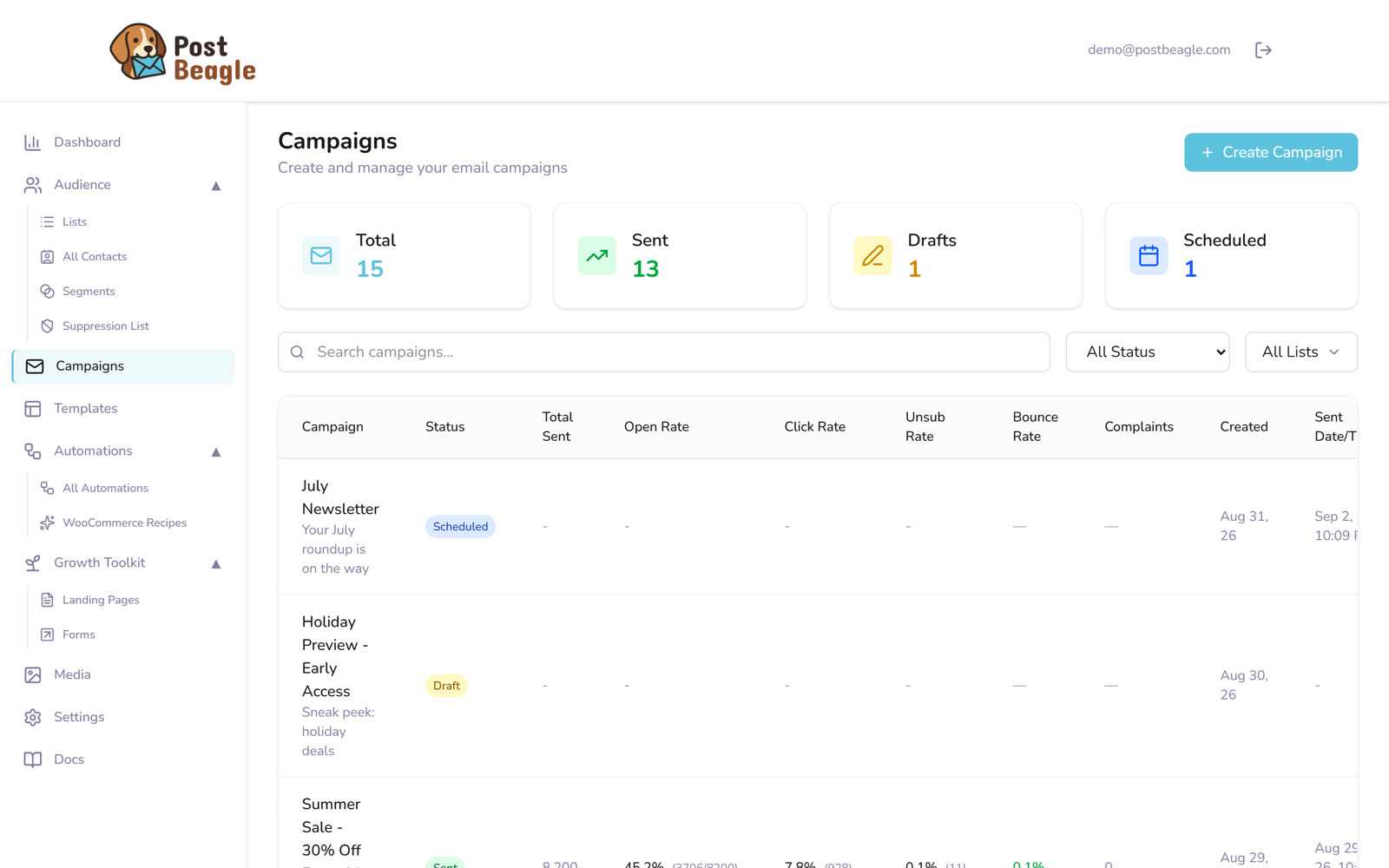
Every send lands in the same table, so the comparison a test makes between two variants is the one you can already make between two campaigns.
Postbeagle makes A/B testing simple and automatic:
Built-in A/B Testing Features
1. Subject Line Testing
- Add up to 5 variants
- Set test percentage (10-50%)
- Automatic winner selection
- Send winner to remaining list
2. Send Time Optimization
- Test multiple send times automatically
- AI-powered optimal time prediction
- Per-subscriber send time optimization
3. Content Testing
- Test different email bodies
- Test CTA variations
- Test personalization strategies
4. Automatic Statistical Analysis
- Real-time significance calculations
- Confidence intervals
- Winner declaration when significant
Your 90-Day A/B Testing Roadmap
Month 1: Foundation
- Week 1-2: Subject line tests (3-4 tests)
- Week 3: Send time test
- Week 4: From name test
Month 2: Optimization
- Week 5-6: CTA tests (2-3 tests)
- Week 7: Email length test
- Week 8: Personalization test
Month 3: Advanced
- Week 9-10: Segmentation tests
- Week 11: Design/layout test
- Week 12: Compile winners, measure cumulative impact
Conclusion
A/B testing isn't optional—it's the difference between mediocre and exceptional email marketing. Start with high-impact tests (subject lines, send time, CTAs), follow a rigorous methodology, and document everything.
Remember:
- Form hypotheses before testing
- Ensure statistical significance before declaring winners
- Test one variable at a time (usually)
- Document and learn from every test
- Keep testing forever—optimization never ends
The marketers who consistently test, learn, and iterate will always outperform those who don't.
Ready to start A/B testing? Try Postbeagle free and get built-in A/B testing tools that make optimization effortless.
Questions about A/B testing strategy? Our team is here to help—reach out anytime.